
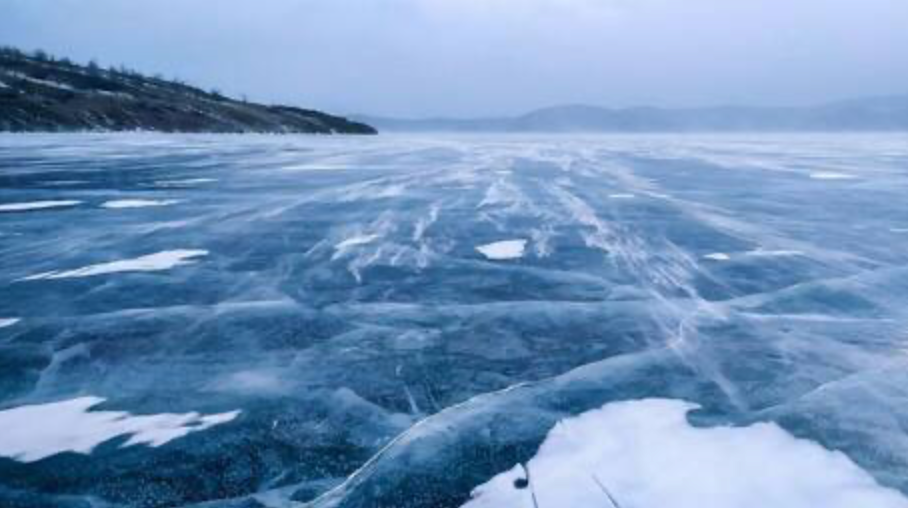
Russian academic Alexander Pichev revealed a satellite image of Lake Baikal provided by the state-run Roscosmos space agency, which showed that no ice had formed even in the northern part of the lake.
Scientists from the Siberian Branch of the Russian Academy of Sciences have emphasized the need for comprehensive scientific research on conditions in Lake Baikal, where an ice cover had not yet formed in January 2025. Academician Igor Pichev, head of the Academy’s Irkutsk Branch, confirmed that the risk of the lake not freezing remains, which could affect the entire ecosystem.
“Even if the ice on the lake is 10 centimeters thick, it is no longer sufficient,” said Pishkov, “because its properties are completely different from those of the 1.5-meter-thick ice that usually forms in winter across the entire Lake Baikal region.”
He stressed the need to immediately begin work on studying the environmental impacts of this rare natural phenomenon.
The Academy’s Presidium endorsed a proposal by Pishkov to prepare a report for the Russian Ministry of Education and Science calling for additional scientific research on the ice conditions in the lake. He presented a satellite image of Lake Baikal showing that ice had not yet formed even in the northern part of the lake. He said there are hydrological, environmental, and other issues, noting that the absence of ice on the lake leads to evaporation of water from its surface and the surfaces of the rivers that feed it. There are also environmental problems. For example, the Baikal seal breeds only at certain temperatures.”
It is worth noting that the area surrounding Lake Baikal has been characterized this winter by warm and stormy weather, The storm that hit the region destroyed a large portion of the ice in the Malui-Mori Strait, which separates Olkhon Island from the Baikal coast, even leading to the postponement of an all-star ice hockey game that was scheduled to take place on the lake’s ice.
It is worth noting that Lake Baikal is one of the world’s natural wonders and is considered the unique jewel of Siberia.
Located in southern Siberia, Russia, it is the deepest freshwater lake in the world, reaching a depth of 1,642 meters. It is also the oldest lake on Earth, estimated to be more than 25 million years old.
The waters of Lake Baikal are among the purest in the world; they are so clear that you can see objects at a depth of 40 meters. This is thanks to microorganisms that naturally purify the water.
It is home to a large number of unique species found nowhere else in the world. One of the most famous of these is the Baikal seal, the only seal that lives in freshwater. The lake is also home to more than 1,700 species of plants and animals, two-thirds of which are endemic to Baikal.
In winter, the entire surface of the lake freezes over, creating a magical ice landscape. The ice is so clear and strong that cars can drive on it. However, climate change is now threatening this ice, which is affecting the lake’s ecosystem.